
What the LinkedIn algorithm 2026 actually rewards

You post on LinkedIn. Some posts get 500 views. Others get 8,000. Same quality content. Same follower count. Different outcomes.
Most founders experience this pattern but don’t understand the system behind it. They assume the LinkedIn algorithm 2026 is random or that success requires going viral. Neither is true. The algorithm operates on specific, measurable ranking signals. Understanding these signals turns inconsistent results into predictable distribution.
Here’s what changed: the LinkedIn algorithm 2026 now favors fast engagement, content type, and smart timing. It matters more than follower count. The platform rewards operational discipline, not viral tactics. This shift creates an advantage for founders willing to implement systematic distribution mechanics rather than chasing engagement bait. Understanding how LinkedIn algorithm works gives you a structural edge over competitors still operating on 2024 assumptions.
The 48-hour distribution window
50% of total impressions on LinkedIn happen within the first 48 hours of posting (Metricool). This isn’t a suggestion. It is the main constraint:
-It shapes every tactical choice.
-It affects when to post.
-It affects how to drive early engagement.
-It affects where to focus after you publish.
The implication: what happens in the first 48 hours determines whether your post reaches 500 people or 5,000. The actions you take immediately after publishing matter more than the content quality itself. Pre-engagement setup, notification timing, and initial responder coordination drive distribution outcomes.
Most founders publish a post, check it once, and move on. The algorithm interprets this pattern as low-value content. Posts that generate no engagement in the first two hours get buried. Posts that generate early comments and shares get amplified to second-degree connections. The difference isn’t content quality. It’s operational execution within the velocity window.
The 90-minute velocity threshold
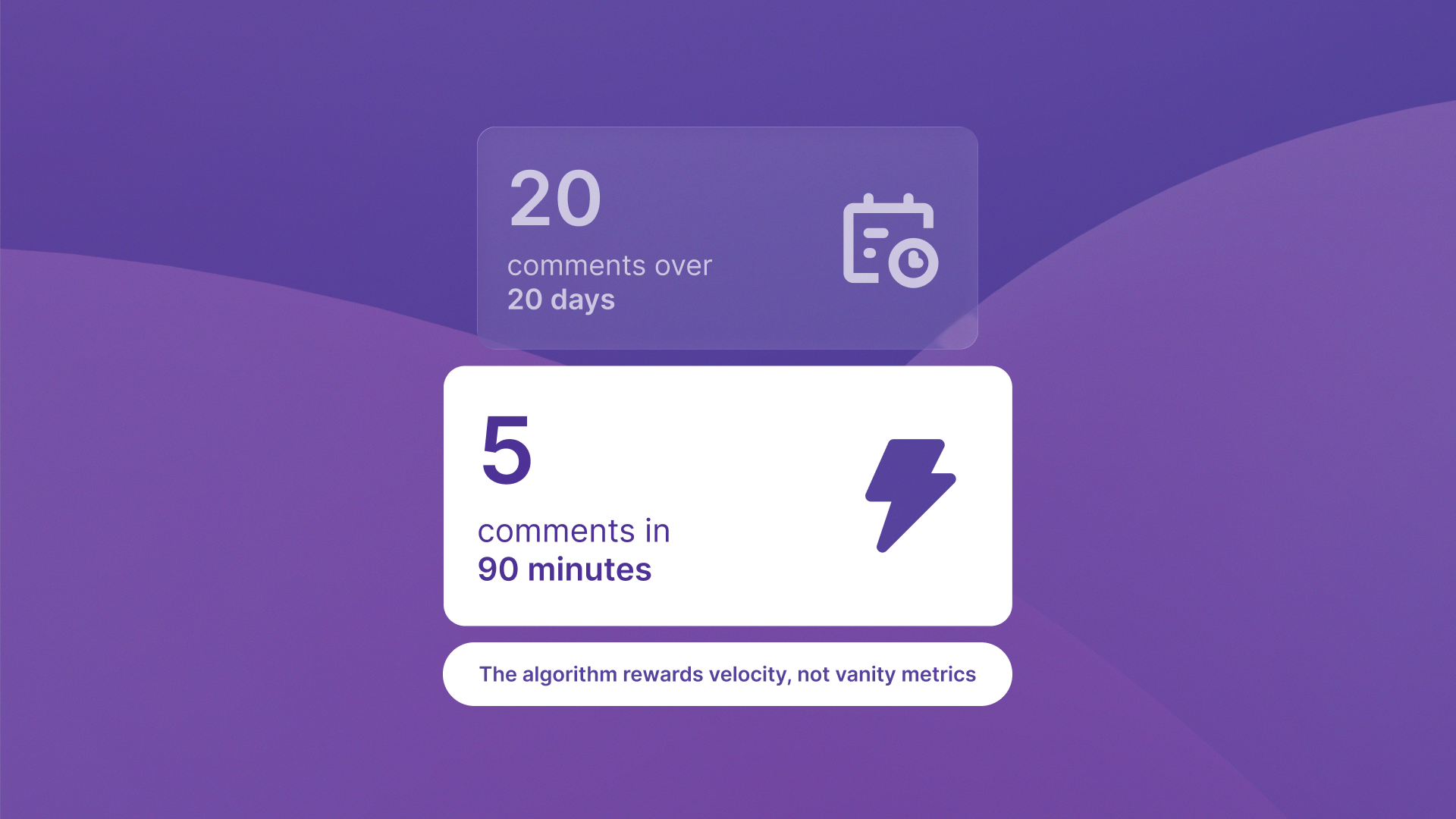
Posts that generate comments within the first 90 minutes receive algorithmic amplification to second-degree connections. This isn’t speculation. It’s how LinkedIn’s machine learning models prioritize distribution. Early engagement signals quality to the algorithm, triggering broader reach.
Here’s what that looks like in practice: you publish a post at 9:00 AM. By 10:30 AM, five people have commented with substantive responses. LinkedIn interprets this as high-value content and pushes it to your commenters’ networks. By noon, the post has reached 2,000 people. Without those early comments, the same post might reach 300.
The tactical shift: optimize for engagement velocity in the first hour, not total engagement over 48 hours. Five comments in the first 90 minutes outperform 20 comments spread across two days. Timing drives distribution more than volume.
Engagement rates increased even as posting frequency dropped
LinkedIn engagement rate increased 13.90% in 2026, even as average posts per week dropped by nearly 10% (Metricool). This reversal reveals a structural shift in how the algorithm evaluates content. Quality and strategic timing now outperform volume.
Founders who posted daily in 2024 saw diminishing returns. Their engagement per post declined as they increased frequency. In 2026, the opposite pattern emerged. Fewer posts with better timing and stronger pre-engagement coordination generated higher engagement rates. The algorithm stopped rewarding high-frequency publishing and started rewarding well-timed, engagement-optimized posts.
QA Flow moved from sporadic to systematic posting, increasing from 6 to 14 posts monthly. Engagement per post doubled. The difference wasn’t posting more often. It was posting strategically within the algorithm’s velocity windows and coordinating early responders before each post went live.
This same pattern appears in other contexts where systematic operational execution beats brute-force volume. Companies can’t solve distribution problems through proportional effort increases. They solve them through smarter systems.
What this means for your LinkedIn posting strategy
Consistency still matters, but strategic execution within each post matters more. Publishing three posts per week with coordinated pre-engagement outperforms publishing five posts per week with no distribution strategy. The algorithm rewards operational discipline over volume.
Here’s the operational shift: block 90 minutes after publishing to respond to every comment within the velocity window. Notify 5-8 genuine connections 10 minutes before posting and ask for thoughtful comments, not generic reactions. Test posting times against your audience’s active hours and measure engagement differences over three posts.
The best time to post on LinkedIn isn’t a universal constant. It’s when your specific network is active. Check your analytics for when your connections are online, then test different time slots within those windows.
Link placement dramatically impacts reach
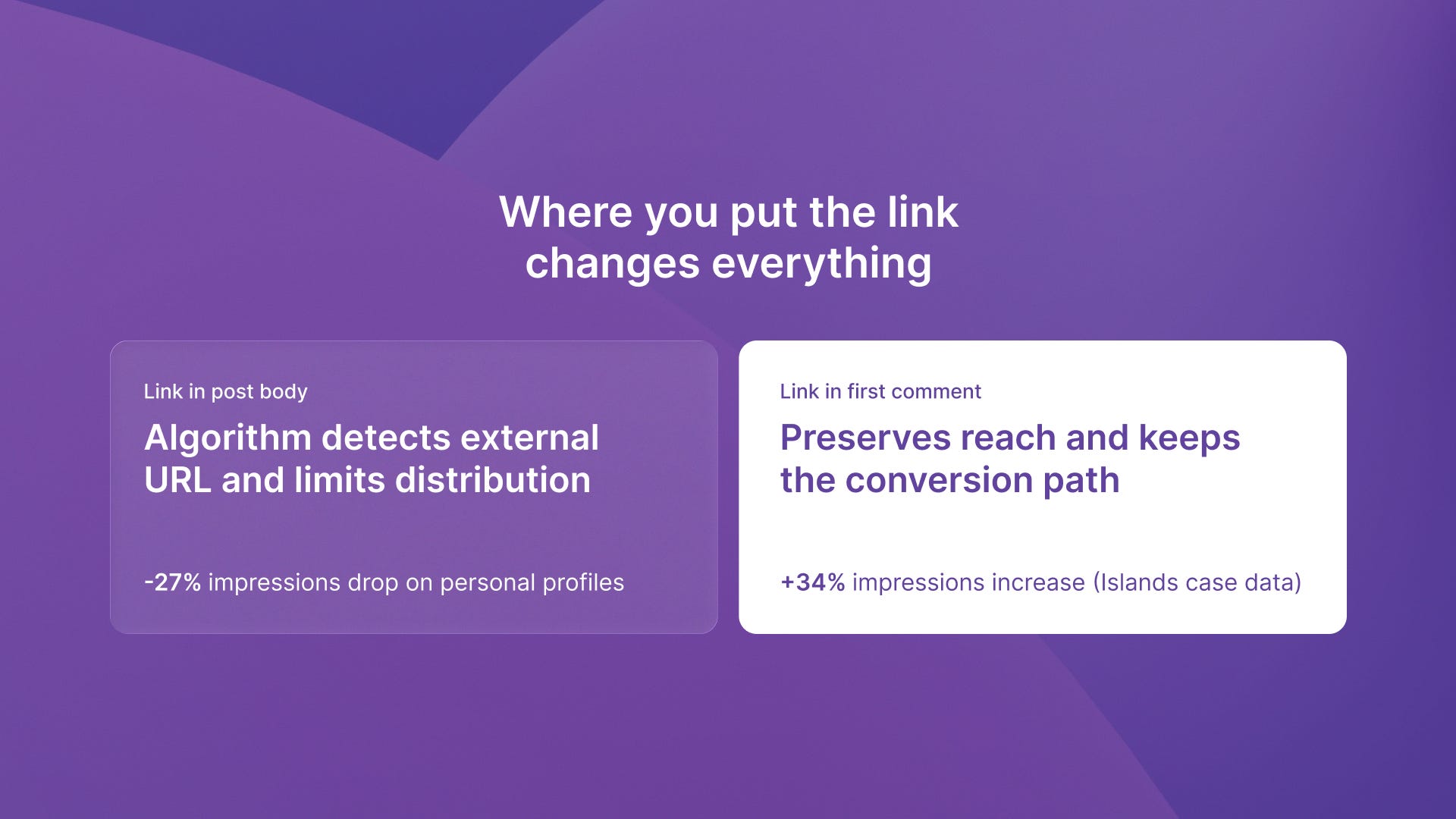
On personal profiles, posts with links see impressions and interactions drop by 27% and 20% respectively (Metricool). The algorithm deprioritizes content that sends users off-platform. This creates structural tension: founders need to drive traffic but the platform punishes explicit linking.
The pattern plays out predictably. You publish a post with a link to your blog in the body. LinkedIn’s algorithm detects the external URL and limits distribution to your immediate network. The post reaches 400 people instead of 2,000. Same content quality, different reach outcome, entirely driven by link placement.
The first-comment workaround
Put external links in the first comment instead of the post body. This preserves reach while still directing interested readers to your content. The algorithm treats first-comment links differently than body links. Impressions stay within normal range while conversion paths remain intact.
Here’s how Islands implemented this: they moved all external links from post bodies to first comments. Impressions per post increased 34% while click-through rates to their landing pages remained constant. Same traffic outcome, better algorithmic distribution, zero change to content quality.
The tactical takeaway: reserve post bodies for native LinkedIn content. Use first comments for URLs. Measure impression differences over three posts to verify the pattern holds for your audience.
This mirrors broader distribution shifts happening across search. Just as AI-powered search engines now prioritize content optimized for machine comprehension. LinkedIn’s algorithm favors engagement on the platform. It values these signals over external traffic indicators and traditional backlink structures.
The algorithm distinguishes between engagement types
LinkedIn’s machine learning models detect artificial engagement patterns and suppress posts that trigger these signals. Coordinated liking, pod behavior, and generic comments all register as low-quality engagement. The algorithm rewards authentic back-and-forth conversation, especially with commenters who have engaged with your content before.
This distinction matters because most engagement tactics founders try actually hurt distribution. Asking for likes in DMs can trigger suppression signals. Joining engagement pods can also trigger suppression signals. Posting in groups that require mutual engagement can trigger suppression signals. The algorithm isn’t optimizing for total reactions. It’s optimizing for genuine conversation.
ReachSocial analyzed this pattern across 12,000 posts. They found that posts with thoughtful comments from repeat commenters got 3.2x more reach. This was true even with the same reaction counts from one-time engagers. The algorithm prioritizes relationship depth over engagement breadth.
Network quality beats network size. A profile with 500 followers and 5% engagement can reach more people than one with 10,000 followers and 0.3% engagement. The algorithm boosts fast engagement, not follower counts.
How to engineer authentic early engagement
Build a core group of 8-12 people in your network who regularly engage with your content. Notify them 10 minutes before publishing and ask for substantive comments, not reactions. Respond to every comment within 90 minutes to trigger additional algorithmic amplification. The goal isn’t more engagement. It’s more authentic engagement within the velocity window.
Here’s the operational protocol: identify who comments most frequently on your posts over the past 30 days. Message them individually before your next post goes live. Ask a specific question they can answer in a comment. When they comment, respond within 15 minutes to trigger additional conversation. This pattern signals quality to the algorithm and extends reach to second-degree connections.
Content format influences distribution independently of topic
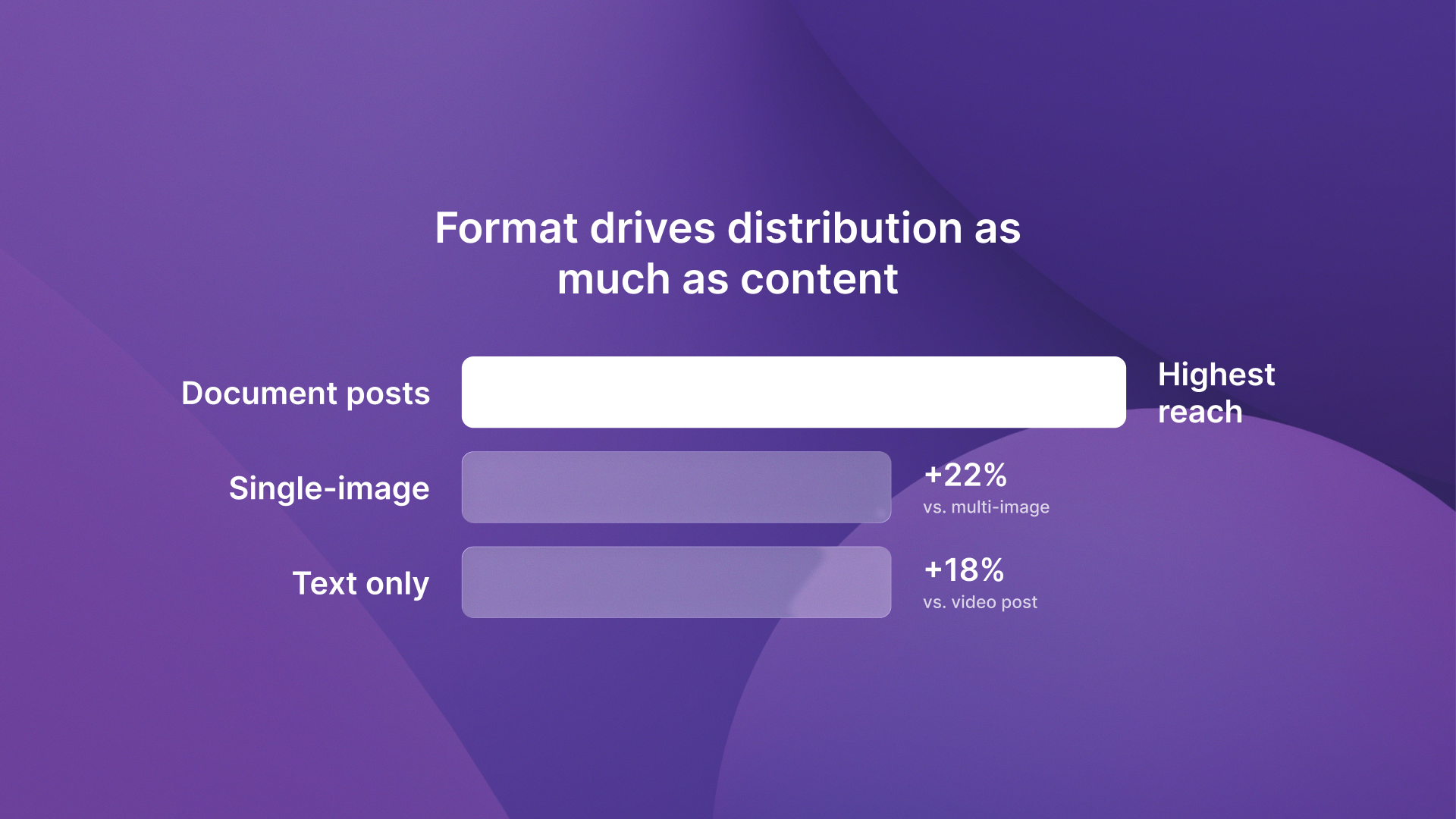
Document carousels, single-image posts with long captions (1200+ characters), and text-only posts with breaks get wider reach.
They perform better than video or multi-image posts. The algorithm seems to favor content that keeps users on the feed, instead of clicking away or scrolling fast.
This format hierarchy isn’t subjective. It’s measurable across post types. Text-only posts with strong formatting generate 18% higher reach than video posts with equivalent engagement rates. Single-image posts outperform multi-image posts by 22% on average. Document carousels receive the highest organic reach of any format.
The implication: format decisions drive distribution outcomes as much as content quality. Choosing the right format for your message matters as much as the message itself. Founders who default to video because it feels more engaging often sacrifice reach without realizing the tradeoff.
Which formats to prioritize
Start with text-only posts for thought leadership and strategic insights. Use single-image posts for data visualization or concept explanation. Reserve document carousels for frameworks, processes, or step-by-step guides. Avoid multi-image posts unless the content genuinely requires comparison across images. Video works for product demos but sacrifices reach for engagement depth.
Test format performance by publishing the same core message across three different formats over three weeks. Measure impressions, engagement rate, and comment quality for each. Most founders discover text-only posts with strong formatting outperform their assumptions about what LinkedIn audiences prefer.
The same principle applies to visibility strategies beyond traditional SEO. CMOs lose brand visibility without answer engine optimization because they optimize for the wrong ranking signals. LinkedIn needs the same strategic shift. Optimize for the algorithm’s real priorities, not what you think they are.
How LinkedIn algorithm changes reward consistent expertise
The October 2025 LinkedIn algorithm changes added LLM embeddings. This shift favored consistent topical expertise over engagement-bait posts. The algorithm now tracks meaning patterns across your post history. It rewards creators who show depth in specific areas, not breadth across unrelated topics.
This means your posting history compounds. Each post on a consistent topic strengthens your topical authority signal. Random posts on disconnected subjects dilute that signal. Semantic ranking rewards consistent expertise over viral posts because the algorithm can now measure real expertise. It can also spot when you are chasing engagement.
The tactical implication: narrow your posting focus. If you cover three distinct topics, consider focusing on one or two core areas. This helps you show real depth. The algorithm rewards specialization more than variety.
What to do next
The LinkedIn algorithm isn’t random. It rewards operational discipline most founders skip. Here’s how to implement these patterns in your next post:
Audit your last 10 posts and identify which had high engagement in the first 90 minutes. Reverse-engineer what you did differently in distribution, timing, and early responder coordination.
Build a pre-engagement protocol: Notify 5–8 real connections 10 minutes before you post. Ask for thoughtful comments, not generic reactions. Track who responds consistently and prioritize those relationships.
Test the link strategy: Put external links in the first comment, not the post body, measure impression changes across three posts. Verify the 27% reach penalty applies to your audience.
Block 90 minutes post-publish to respond to every comment within the velocity window. Schedule posts for your audience’s active hours (check your analytics for when your connections are online).
If you track content performance across platforms, you need a system that saves billable time. Managing LinkedIn engagement workflows by hand creates extra overhead. The same pattern appears when agencies misclassify billable work as relationship-building, losing $32,500+ annually per project. Time allocation matters.
For beauty ecommerce brands managing social content across multiple platforms, a structured 30-day content calendar eliminates the weekly scramble. The same systematic approach applies to LinkedIn: batch planning removes activation energy.
If you are assessing technical talent to build content systems, consider Canadian engineers. Canadian engineers cost 40-50% less than US equivalents. They still deliver the same quality. Nearshoring to Canada creates operational advantages for content infrastructure buildout.
The LinkedIn algorithm 2026 changes happened, but most founders are still operating on 2024 assumptions. Understanding the systematic patterns gives you a structural advantage. The operational discipline required to execute these patterns is exactly what separates consistent growth from inconsistent results.
Ready to automate your LinkedIn workflow and turn these insights into consistent results? Start building your system today.